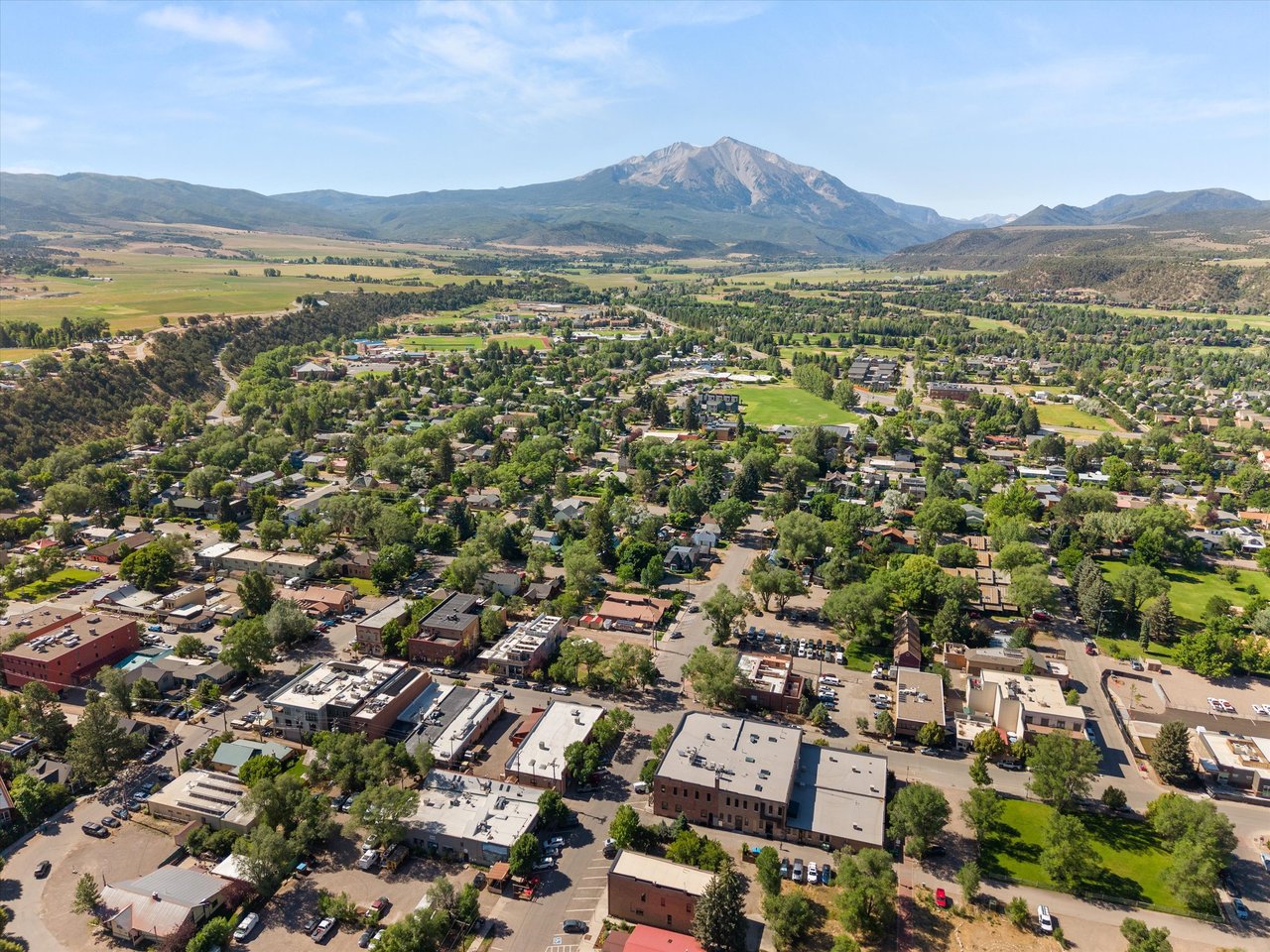
Call around Main Street in Carbondale looking for a storefront and you will hear some version of the same sentence: it's basically full. That matches the last hard number anyone published. The Sopris Sun's annual commercial inventory, compiled by walking the town block by block rather than pulling from a government database, put Carbondale's commercial occupancy at roughly 96 percent as of its July 2025 count. For a business owner or investor comparing towns in the valley, that sounds like a straightforward signal: tight market, move fast, expect to compete.
It is straightforward right up until you ask where the empty 4 percent actually is. It is almost entirely on one side of town, and the reason has less to do with demand than with how space actually changes hands here.
What 96 Percent Occupied Actually Means
The Sopris Sun has run this count since 2017 because no other source does it consistently. Carbondale doesn't issue business licenses, and the Chamber of Commerce only tracks its own members, so nobody has a clean administrative record of who is open, who left, and who took over the space. The Sun's method is closer to a broker's site walk than a spreadsheet: check every building, note what's occupied, note what's for lease.
That method is why the number is useful and also why it can mislead. A single town-wide percentage flattens two buildings that behave nothing alike. The Third Street Center, for instance, was described in the same report as effectively vacancy-free. A newer commercial building across Highway 133 from downtown sat with close to 10,000 square feet empty since the day it was completed. Averaged together, both feed the same 96 percent. Neither tells you anything about the other.
The Dinkel Building Shows How Main Street Actually Turns Over
The clearest example of why downtown space almost never shows up as available is the Dinkel Building, a longtime anchor of Main Street. When the property changed ownership, the transition did not result in the building being cleared and re-leased at entirely new terms. Instead, existing tenant relationships largely remained in place, including longtime businesses such as Steve’s Guitars and The Nugget, along with newer additions like The Crow and Key. One storefront did change use: Strange Imports gave way to Mountain Tide Provision Co., a new addition to that stretch of Main Street.
That sequence is the actual mechanism behind Main Street's tight number. Turnover happens through private negotiation between a landlord and a sitting tenant, not through a space hitting the open market and drawing bids. If you are a business owner trying to break into a Main Street address, you are not really competing against other applicants for a listed vacancy. You are waiting for a relationship to end, and most of the time it doesn't.
A few other Main Street and Highway 133 changes from the same reporting period illustrate the same pattern: businesses and uses change, often without the underlying space ever sitting publicly vacant for long.
- Main Line Social opened on the site of a former strip mall along Highway 133, while the historic building at 689 Main Street is also being repositioned for a new restaurant concept.
- Aspen Barbershop moved from its former home in the Sopris Liquor & Wine building into the Carbondale Marketplace development.
- A new diner, 502 Diner, named for Guatemala's country code and built around a Central American take on classic diner food, took over the space Honey Butter's left behind.
- Plans have also been submitted for an 11-room boutique hotel at 888 Main Street, adding another potential use to the evolving mix along the downtown corridor.
None of that necessarily shows up as vacancy in a town-wide count. It is often one business, use, or ownership strategy evolving into another inside space that may never have been broadly exposed to the market. That is an important distinction when trying to understand the actual health and availability of a local commercial district.
Highway 133 Tells a Different Story
The corridor along Highway 133, where nearly all of Carbondale's new commercial square footage is landing, works on a completely different clock. This is where actual vacancy has shown up and stayed. Space at Hayden Place, built on the former Sopris Shopping Center site, has sat empty at close to 10,000 square feet since construction finished, according to the same Sopris Sun count. That is real, visible, market-facing vacancy, the kind a broker can walk you through today.
It is also where the next wave of supply is arriving. ANB Bank broke ground in April 2025 on Sopris Station, a 27,000-square-foot mixed-use project between Highway 133 and Hendrick Drive, replacing the bank's existing branch a short distance north. The project pairs a relocated banking center with roughly 10,000 square feet of leasable commercial space, built with restaurant use in mind, plus 16 apartment units. Community Bank President Tony Spires framed it as a chance to serve customers more efficiently while adding housing for staff and the broader community. ANB's own materials put completion in fall 2026, which means as of this writing the building is either finished or close to it.
Separately, new retail space adjacent to the incoming City Market building, connected to the future ANB location, has been marketed at roughly $48 per square foot per year, with interior layout and highway frontage built in from the start. Across the broader inventory tracked by commercial listing services, office space in Carbondale has run from roughly $29.50 to $42 per square foot annually, and retail from about $22 up to $48, with most quotes clustering in the mid-$30s to low $40s.
Put those two facts next to each other and the picture is not "Carbondale is full." It is "Carbondale's old core is full and its highway frontage is about to test whether the town can absorb a real block of new supply at once."
Two Markets, One Number
Main Street Core | Highway 133 Corridor | |
|---|---|---|
How space turns over | Private negotiation between landlord and tenant | Public listings, new construction |
Recent vacancy | Effectively none (Third Street Center, Dinkel Building) | Real and visible (Hayden Place) |
What's arriving | Concept changes inside existing buildings | New square footage (Sopris Station, City Market-adjacent retail) |
What it rewards | Existing relationships and patience | Being ready to move when new space delivers |
Occupancy is only one part of the equation. A healthy commercial district also depends on whether the economics work for everyone involved. Property owners need rents that support the cost of owning and maintaining their buildings. Businesses need enough margin to employ people, reinvest, and stay open. Customers need prices they can afford. And the community depends on those businesses generating jobs, activity, and tax revenue.
When those numbers fall out of balance, a commercial district can look full on paper while becoming increasingly difficult for local businesses to operate in. That is the broader Math of Main Street behind the occupancy numbers.
A Historic Downtown Boundary Change in the Old Core
There is one more piece that matters specifically if you are looking at buying or renovating a building in the old core rather than leasing in it. According to The Sopris Sun, in April 2026 Carbondale's Board of Trustees approved an ordinance expanding the town's Historic Downtown Area to formally include the Historic Commercial Core, the blocks on both sides of Main Street.
What This Means If You're Comparing Carbondale to Other Roaring Fork Towns
A single occupancy percentage is a fine headline and a poor decision tool. In Carbondale specifically, the number is really an average of a core that doesn't turn over in public and a corridor that is about to add a meaningful chunk of new space all at once. Those are two different opportunities with two different timelines. One rewards a business owner willing to wait for a relationship on Main Street to shift. The other rewards someone positioned to act as soon as Sopris Station and its neighboring retail deliver.
Reading the market by asking which of those two situations actually applies to the address you're considering, rather than trusting one town-wide figure, is the difference between an offer that makes sense and one built on the wrong half of the data.
Commercial real estate works best when the economics make sense on both sides of the lease. Owners need sustainable returns. Businesses need sustainable occupancy costs. And communities need businesses that can hire people, serve customers, generate tax revenue, and remain part of the local economy.
That balance is something we spend a lot of time thinking about at C&E Group. If you're considering a lease, purchase, or location decision in Carbondale or elsewhere in the Roaring Fork Valley, we can help you understand what the numbers behind a specific property actually mean for your business or investment.
Frequently Asked Questions
If Main Street space rarely gets listed publicly, how would I even find out about an opening? Most turnover happens through direct relationships between landlords and prospective tenants before a space is ever advertised. Working with a broker who maintains those relationships is generally the only way to hear about a change before it's already decided.
When will the new retail space near Sopris Station and City Market actually be available to lease? ANB Bank's own materials targeted fall 2026 for the Sopris Station project, and nearby retail space connected to the new City Market building has been marketed for availability in late 2026. Anyone interested should confirm current status directly, since these timelines can shift as construction finishes.
This article is general information, not legal, tax or financial advice. Consult a qualified professional about your situation.